lunes, 4 de febrero de 2019

A/an, the, no article

A/an, the, no article

The Indefinite Article – A / AN

We use A/AN with:
1. Singular nouns and the first time we refer to a person, animal or thing.
  • a child
  • an elephant
  • a television
2. We don't use A/AN with possessive pronouns, demonstratives or cardinal numbers.
  • My shirt is dirty.
  • This car is expensive.
  • One person is in the reception.
3. We use ONE (or more) instead of A/AN when the number is important.
  • There is only one exit from the airport.
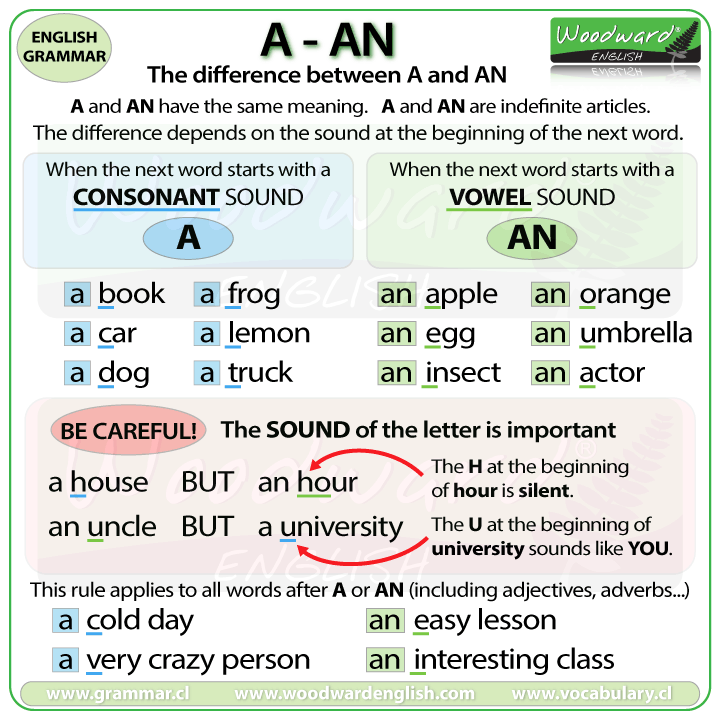
A is used when the next word begins with a consonant sound (b, c, d, f, g, h, j, k etc).
  • a book
  • a table
  • a clock
  • a university (because the beginning of university sounds like YOU-niversity)
AN is used when the next word begins with a vowel sound (a, e, i, o, u).
  • an apple
  • an elephant
  • an umbrella
  • an hour (because the H is silent)
Try our game to practice the difference between A and AN.

The difference between A and AN in English

The Definite Article – THE

We use THE with:
1. A singular or plural noun when it is clear/obvious which person or thing we are talking about.
  • There is a lamp in my bedroom. (we mention the lamp for the first time)
  • The lamp is next to the desk.
2. Anything which we identify immediately.
  • We watched the new Brad Pitt movie last night.
3. Musical instruments (the violin, the guitar, the drums, the flute, the piccolo).
  • She plays the piano.
4. Something that is unique or there is only one.
  • the sun
  • the moon
  • the internet.
5. Names of rivers, seas, oceans, mountain ranges and deserts (always in capitals).
  • The Mississippi River
  • The Black Sea
  • The Andes
  • The Sahara Desert
6. Directions (cardinal points).
  • the west
  • the south-east
  • the north-west.

No Article

We use no article with:
1. When we refer to general ideas, plurals or uncountable nouns we do not use THE.
  • Religion is an important issue. (NOT The religion is an important issue)
  • Mexican food is spicy. (NOT The Mexican food is spicy).
2. Names of people, books and plays (unless it is part of the title).
  • I have read Romeo and Juliet.
3. Towns, cities, states and countries.
  • Cape Town
  • Montana
  • Vietnam
(Exceptions – The USA, The UK, The Netherlands, The Czech Republic, The Philippines).
4. Lakes, single islands, continents or mountains.
  • Lake Victoria
  • Jamaica
  • Asia
  • Mt Fuji
5. Planets
  • Mars
  • Jupiter
  • Saturn
6. Sports or games
  • soccer
  • tennis
  • skiing
  • monopoly
7. Meals
  • breakfast
  • lunch
  • dinner
  • supper
Some practice: Practice 1, Practice 2, Practice 3


lunes, 19 de enero de 2015

GIVING DIRECTIONS

http://www.cepagernika.com/wordpress_blogingles/?page_id=363

Word List

Asking for and Giving Directions
How do I get to …?
What's the best way to …?
Where is …?
Go straight on (until you come to …).
Turn back./Go back.
Turn left/right (into …-street).
Go along …
Cross …
Take the first/second road on the left/right
It's on the left/right.
straight [streɪt] on
opposite ['ɒpəzɪt]
near [nɪə]
next to
between [bɪ'twiːn]
at the end (of)
on/at the corner
behind [bɪ'hʌɪnd]
in front of
(just) around the corner
traffic lights
crossroads, junction [ʤʌŋ(k)ʃ(ə)n]
signpost ['sʌɪnpəʊst]


http://www.slideshare.net/oseiasa/giving-directions-presentationoseiasamodelo
http://learnenglishteens.britishcouncil.org/skills/listening-skills-practice/giving-directions
http://tastythailand.com/free-eflesl-lesson-plan-how-to-give-directions-easily/
http://www.freddiesville.com/games/giving-directions-interactive-esl-board-games/
http://www.funenglishgames.com/readinggames/directions.html
http://www.englishexercises.org/makeagame/viewgame.asp?id=1434

PLACE PREPOSITIONS

http://englinea.com/prepositions-of-time-and-place/
American town

miércoles, 18 de mayo de 2011

OBJECT PRONOUNS

Object Pronouns (Pronombres Objetos) son pronombres que reciben la acción del verbo. Se colocan:

I. Después de un verbo:

          I call her every day.     La llamo todos los días.

II. Después de una preposición:

         The present is for her.       El regalo es para ella.


Subject Pronouns Object Pronouns
I I kicked the ball me John kicked the ball to me.
you You like to study. you John wants to talk to you.
he He eats green cheese. him Mary doesn’t like him.
she She likes ice cream. her John kissed her.
it It bit John. it John smashed it.
we We enjoy going to the movies. us The politician lied to us.
you You are the best students. you I wouldn’t lie to you.
they They are not happy. them Mary didn’t invite them.

Now practice
Exercise 1
Exercise 2
Exercise 3
Exercise 4
Exercise 5

domingo, 1 de mayo de 2011

COMPARATIVES AND SUPERLATIVES


COMPARATIVES:
                     1.- Igualdad:        As+ adjective + As
                                                     John is as tall as George.
                     2.- Superioridad: 
                                                  1 syllable   Adjective+er + than.
                                                     Peter is taller than María.
                                                  2 syllables  Adjective  ending in y ,er,ow,le+er
                                                     Maggie is prettier than his sister.
                                                     Susie is cleverer than Joe.
                                                     A stream is narrower than a river.
                                                     James is humbler than your sister.
                     -----------------------------------------------------------------------------------------
                                                 2 syllables NOT ENDING -y, -er, -ow, -le  AND
                                                 3 or more syllables  more+Adjective + than
                                                     The chair is more comfortable than the sofa..
                   
                     3.- Inferioridad :     Less + Adjective + than
                                                    He is less intelligent than his daughter.

SUPERLATIVES:

                                       1 syllable The + Adjective + est.
                                                     Peter is the tallest.
                                       2 syllables  the+ Adjective ending -y,er,ow,le+est
                                                     Maggie is the prettiest.
                       --------------------------------------------------------------------------------------
                                       2 syllables  not ending -y,er,ow,le: the most + adj
                                       3 or more syllables The most + Adjective.
                                                     This chair is the most comfortable of all.

          EXCEPTIONS TO THE RULE:

            ADJECTIVE              COMPARATIVE            SUPERLATIVE

            Good                                better than                              the best
            Bad                                  worse  than                             the worst.
            Far                                 farther/further                 The farthest/The furthest

 Grammar summary

PRACTICE
   
   Exercise 1

PRESENT SIMPLE vs PRESENT CONTINUOUS

Let's review the Present tenses!!!! 


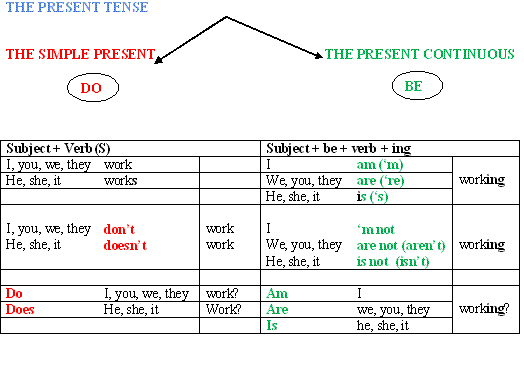
Structure differences

Present Simple:

- Maria plays tennis at the weekends
- She doesn’t study French.
- How many children do they have?

Remember:
- In positive we use two conjugations. One is the simple form and the other is the “s” form (play/plays)
- In negative sentences we use the auxiliaries don’t and doesn’t and the verb is ALWAYS in the simple form. (She doesn’t work)
- In the question form we use auxiliaries do and does and also the verb goes in the simple form. The subject goes in between the auxiliary and the verb. (Do you work here?)

Present continuous

- Maria is playing tennis.
- She isn’t studying.
- What are they doing?

Remember:
- When we form the present continuous we use the verb to be. Therefore we DO NOT USE auxiliaries do, does, don’t or doesn’t.
- Use the “ing” form after the verb to be. 

USES COMPARISON
Present SimplePresent Continuous
Routines / Habits : Maria smokesActions happening NOW: Maria is smoking
Permanent Actions: Pedro lives in SevillaTemporary actions: Juan is staying at the Marriot hotel.
Current facts/truths: I have two brothers


Practice 1
Practice 2
Practice 3


jueves, 10 de marzo de 2011

Tongue twisters

Tongue twisters

Listening to tongue twisters is one way to improve your English pronuniciation. It's very difficult to say tongue twisters in English so don't worry if you can't do it very well at first, just have fun!
  • a laughing zebra
    Listen to the tongue twister and practise saying it. How fast can you say it?
    "Zebras zig and zebras zag."

     
  • an owl
    Listen to the tongue twister and practise saying it. How fast can you say it?
    "Eleven owls licked eleven, little, liquorice lollipops."

     
  • a red lorry
    Listen to the tongue twister and practise saying it. How fast can you say it?
    "Red lorry, yellow lorry."

     
  • kids pointing
    Listen to the tongue twister and practise saying it. How fast can you say it?
    "Not these things here, but those things there."

     
  • a beetle
    Listen to the tongue twister and practise saying it. How fast can you say it?
    "The big bug bit the little beetle, but the little beetle bit the big bug back."

     
  • woodchuck
    Listen to the tongue twister and practise saying it.
    "How much wood would a woodchuck chuck if a woodchuck could chuck wood"

     
  • six coloured pencils
    Listen to the tongue twister and practise saying it. How fast can you say it?
    "I can think of six thin things, but I can think of six thick things too."

     
  • big black dog with a sore nose
    Listen to the tongue twister and practise saying it. How fast can you say it?
    "A big black bug bit a big black dog on his big black nose."

     
  • Red leather jacket
    Listen to the tongue twister and practise saying it. How fast can you say it?
    "Red leather yellow leather."
    A
     
  • girl kissing puppy
    Listen to the tongue twister and practise saying it. How fast can you say it?
    "Quick kiss, quick kiss, quick kiss."
     

Sports

Common Sports

archery
badminton
cricket
Cycling
Archery
Badminton
Cricket
Cycling
darts
Football
golf
horse racing
Darts
Football
Golf
Horse Racing
snooker
squash
ping pong
tennis
Snooker
Squash
Table
Tennis
Tennis

Contact Sports

boxing
cricket
rugby
wrestling
Boxing
Judo
Rugby
Wrestling

Water Sports

angling
canoeing
kayaking
Angling
Canoeing
Kayaking
rowing sailing waterski
Rowing Sailing Water Skiing

Winter Sports

Curling
ice skating
skiing
Curling
Ice Skating
Skiing

Less Usual Sports

croquet
fencing
hockey
Croquet
Fencing
Hockey
lacrosse
polo
skeet
Lacrosse
Polo
Skeet